Iowa Hog Barn Converts to Mushroom Factory
The Faaborg family in central Iowa replaced 8,000 annual hogs with specialty fungi, creating a new model for retiring concentrated animal feeding operations.
By Jack Weber ·
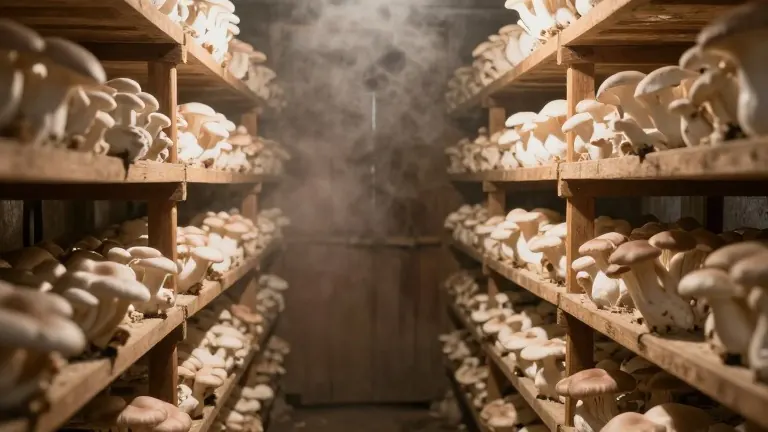
For decades, the Faaborg farm in central Iowa produced 8,000 hogs a year. Today, that production has ceased. In its place, the family grows specialty mushrooms inside a retrofitted barn. The shift aims to replace intensive livestock work with a smaller, more profitable agricultural model.
The operation, named 1100 Farm, references the capacity of its two main buildings. Each structure once held 1,100 pigs. The family began the transition in 2021 with technical support from The Transfarmation Project, an initiative by the charity Mercy for Animals. They sold their last herd of hogs in 2022. A $15,000 grant in 2023 funded a one-year pilot project for mushroom cultivation.
The farm was a concentrated animal feeding operation, or CAFO. The U.S. Environmental Protection Agency defines these as facilities that confine large numbers of animals without vegetation for at least 45 days a year. Iowa leads the nation with 3,938 such operations as of 2024. The Faaborgs’ previous setup generated roughly one million gallons of liquid manure annually, stored in an open pit until hauled away for field application.
Tanner Faaborg, who proposed the change, cited a double life between his sustainability work in Des Moines and his farm duties. He wanted to use the existing infrastructure for something healthier for the family and the environment. His father, Rand Faaborg, agreed to exit the hog business after 35 years. Rand noted that his welding pay increased tenfold while his income from raising hogs dropped by two-thirds.
The family completed the conversion of half of one 200-foot-long barn this summer. The space now serves as a demonstration hub for Transfarmation. Katherine Jernigan, the organization’s director, stated the site allows other farmers to see the transition firsthand and collect data on costs and labor. The Faaborgs receive $216,000 over four years to track and share this information. The first such hub is located in North Carolina.
The family sells their mushroom products, including tinctures, coffee blends, and flavored salts. They are currently scaling up production after a successful pilot. Tyler Faaborg, who marketed 200,000 hogs a year for 25 years, joined the effort after years of physical strain. The family plans to sell fresh mushrooms to a few companies and may convert the second barn for microgreens.
The transition has altered the farm's physical landscape. A former manure pit, funded for remediation by a USDA grant, is now a freshwater pond. Rand Faaborg said the change eliminated his anxiety over manure levels and provided a habitat for frogs and ducks. The family has also planted native grasses, wildflowers, and hundreds of trees to support pollinators and improve water quality.
Tanner Faaborg envisions the empty grain silo as a visitor lodging space. He hopes the farm serves as a proof of concept for other rural areas. The family aims to show that repurposing industrial animal agriculture infrastructure can be a viable and profitable path for the next generation of farmers.
More Business · Rip-Off Report · Report a business · Got a Story?