Jakarta Security: Indonesia Moves 20,000 Troops Amid Police Wiretap Scandal
The military deployment follows the detention of three generals, including the former police chief, in a probe into unauthorized surveillance of the president.
By Jack Weber ·
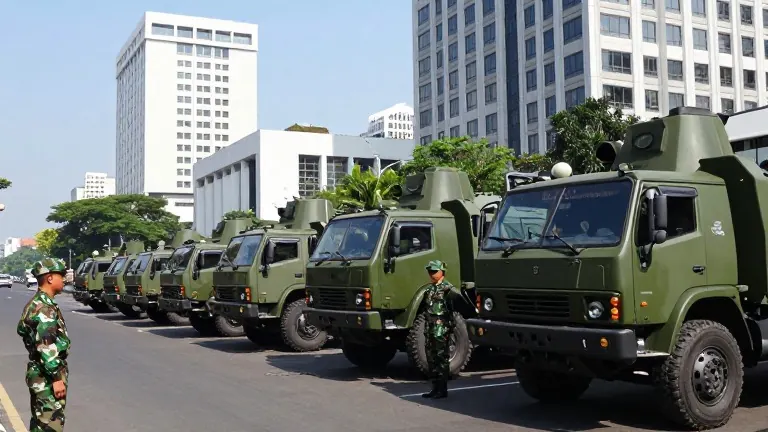
Jakarta authorities moved more than 20,000 military personnel into the capital on Wednesday, a shift that coincided with the arrest of three senior police officials in a high-profile wiretapping investigation. The troop surge, which began on Monday, is currently unfolding while the police continue their inquiry into unauthorized surveillance activities that allegedly targeted the head of state.
Vice Adm. Yayan Sofiyan, the navy operations assistant, provided the specific figures for the deployment. The first phase involved 2,100 personnel already stationed in the city. Additional units from marine and navy divisions, training centers, and bases in Java and Lampung province arrived on Wednesday, bringing the total count to 20,980. Sofiyan noted that another 13,140 personnel remain on standby for immediate deployment if required.
Maj. Gen. Muhammad Nas, the spokesperson for the Indonesian armed forces, characterized the movement as a standard protocol. He stated that such deployments are a normal occurrence designed to maintain national security and territorial integrity. Nas emphasized that the military must always be prepared to protect the nation and safeguard the integrity of the Republic of Indonesia, though he did not specify if the move was directly linked to the police probe.
The investigation centers on three detained generals: Listyo Sigit Prabowo, Ahrie Sonta Nasution, and Eko Hadi Santoso. Police announced their detention late Tuesday, revealing that the suspects were held on Sunday. Listyo, who served as national police chief from January 2021 until last month, was appointed as presidential chief of staff in October. President Prabowo Subianto dismissed Listyo from that new role on Wednesday. The other two generals were previously senior figures in the police hierarchy.
Police allege the unauthorized wiretapping occurred between 2025 and 2026. The suspects are accused of ordering the interception without following proper procedure and subsequently deleting files containing the intercepted communications in late October. The deletion was allegedly an attempt to conceal evidence. The charges involve illegal interception of communications, unlawful access to electronic systems, and the deletion of electronic data.
Minister of State Secretariat Prasetyo Hadi addressed the implications of the case at a news conference at the presidential palace. He stated that the surveillance of a head of state raises serious national security concerns because it exposes highly sensitive information. Hadi described the conduct as potentially leading toward treason, arguing that it endangers state interests and national leadership. The government is waiting for the police investigation to conclude before determining the specific motives of the suspects.
Legal experts suggest the stakes are higher when a sitting president is the target. Bambang Rukminto, a police analyst at the Institute for Security and Strategic Studies, noted that intimidating a president is not a plausible explanation for the motive. He argued that investigators must look beyond the perpetrators to identify who benefited from the information. Adrianus Meliala, a criminologist at the University of Indonesia, said the case could reflect political maneuvering rather than standard police work.
The three suspects face potential prison sentences of up to ten years. The charges relate to unlawful interception, recording, diversion, alteration, obstruction, or monitoring of nonpublic electronic communications. None of the suspects have made public statements regarding the allegations since their detention on Sunday.