Lorita Santos visits father's grave in Manila as thousands honor the dead
Filipino families gather at cemeteries for Undas, a two-day observance that blends Catholic rites with pre-colonial ancestor veneration.
By Alexei Brooks ·
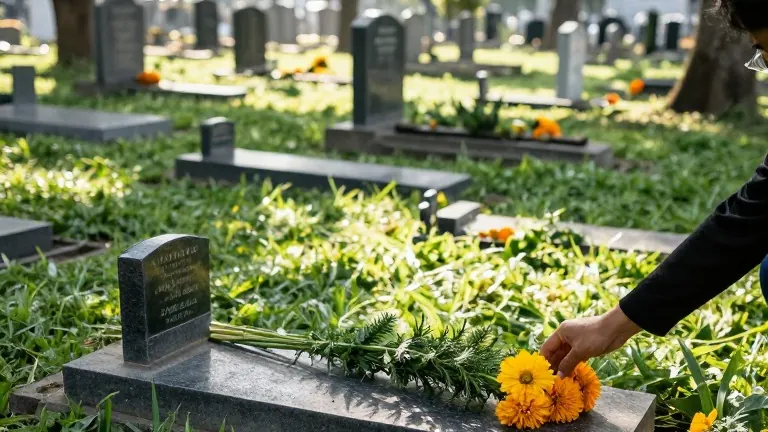
Manila cemeteries filled on Sunday with thousands of visitors marking All Saints' Day, a tradition known locally as Undas.
Lorita Santos stood at the resting place of her father and three other relatives. She kept the memories of their shared time close, a practice she has maintained since childhood.
Santos explained that passing away does not mean forgetting. Her family honors the occasion by placing flowers and candles on the graves. They also pray together and share snacks during the visit.
The gathering served as a time for Santos to recall specific moments with her late father. She remembered how he gave small gifts to his children and grandchildren every payday. "We will never forget that," she said.
Santos now teaches her own children to visit graves. She noted that she grew up doing this even outside of All Saints' Day. "We pass this on to our children to make sure they are aware of the tradition, so that if something happens to us, they know what to do," Santos said.
The observance spans November 1 and 2, covering All Saints' Day and All Souls' Day. The name Undas derives from the Spanish word "honras," meaning honors. The practice incorporates Catholic observances introduced by the Spanish, who arrived in 1565.
Nestor Castro, an anthropology lecturer at the University of the Philippines Diliman, stated that ancestor veneration in the Philippines predates Spanish colonization. Before the arrival of Catholicism, Filipinos honored ancestral spirits known as anito by offering food and gifts. These practices formed a continuous tradition of ancestor worship.
Castro noted that the Manila-Acapulco galleon trade connected the Philippines and Mexico for centuries during the colonial era. Both countries now share similar customs for honoring the dead. In Mexico, families spend time at graves or set up altars with marigolds, music, and food. Similar gatherings occur in Bolivia, Poland, and Hungary.
In Filipino culture, these events bind families together. Castro explained that funeral wakes often wait for distant relatives to arrive before burial. "That's when family reunions occur. It's a binding event," he said. Families often share sticky rice cakes during Undas, a food whose texture symbolizes the bonds between relatives. "These events foster and solidify kinship relationships," Castro added.
Mike Mamaril, a 42-year-old school maintenance employee, visits his parents' graves annually. He said the custom was passed down from his grandparents. He makes time for the visit even though he rarely gets another opportunity to go. The gathering allows him to reminisce about his parents and childhood moments. "We always talk about who among us got scolded the most," Mamaril said.