Scott Petersen Seeks to End All-Mail Voting in Eleven Rural Nebraska Counties
The Republican nominee for secretary of state proposes in-person options, challenging a system that has boosted turnout and saved costs since 2005.
By Alexei Brooks ·
Scott Petersen, the Republican nominee for Nebraska secretary of state, has proposed ending the practice of conducting elections entirely by mail in the state's smallest counties. He seeks to replace the current automatic mailing of ballots with in-person voting options, arguing that technology can make polling places accessible to rural residents without requiring every county to rely solely on mail.
Petersen, who defeated incumbent Bob Evnen in the May primary, claims that extended mail voting encourages outside groups to collect ballots and influence elections. His proposal stands in contrast to the current system, which has been in place for over two decades in specific rural areas to reduce administrative costs and improve voter access.
Eleven Nebraska counties, including Morrill, Boone, Cedar, Cherry, Clay, Dawes, Dixon, Garden, Knox, Merrick, and Stanton, currently hold elections entirely by mail. These counties are eligible for this status because they have fewer than 10,000 residents. All eleven supported President Donald Trump by wide margins in the 2024 election, with support ranging from 71% in Dawes County to 90% in Cherry County.
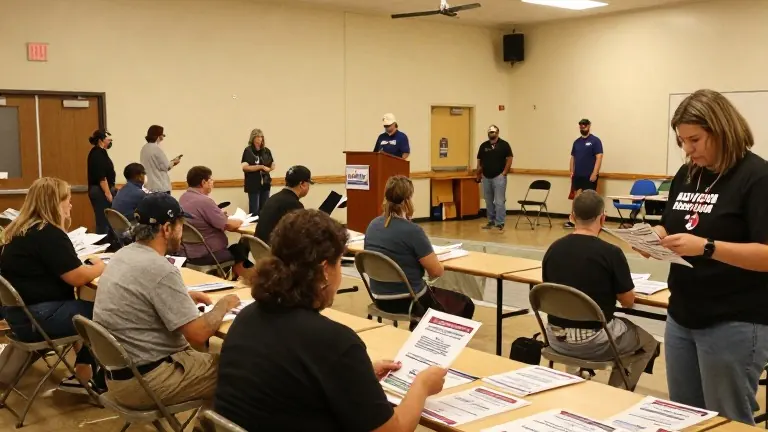
Candace Panas, the election commissioner for Morrill County, stated that all-mail voting saves the county money by eliminating the need to set up polling places and hire poll workers. She noted that her budget does not allow for the equipment and personnel required for in-person voting. Panas also pointed to recent flooding and wildfires that have made some rural roads in the county impassable, further complicating access to physical polling locations.
Data indicates that all-mail voting correlates with higher participation. In the 2022 midterm election, turnout in the eleven all-mail counties averaged 69%, compared with 55% statewide. A 2024 analysis by Flatwater Free Press found that the number of ballots cast in these counties increased by an average of 16% between the 2016 and 2020 presidential elections as they transitioned to all-mail voting.
The shift to all-mail voting in small counties began in 2005, when Republican state Sen. Deb Fischer sponsored legislation allowing the practice. Fischer cited the high cost of maintaining accessible voting machines in sparsely populated areas. Prior to that, Nebraska had become a no-excuse mail voting state in 1999, a move supported by both parties and signed into law by then-Gov. Mike Johanns.
Dave Shively, who headed elections in Lancaster County from 1999 to 2023, said the change increased the number of consistent voters. He observed that many residents who receive ballots in the mail send them in every election, whereas they might skip lower-turnout contests if they had to travel to a polling place.
Petersen faces an incumbent system defended by Evnen, who noted that 300,000 registered voters chose to vote by mail in the 2024 general election. Evnen emphasized that the state works hard to ensure mail voting is honest. Meanwhile, Republican lawmakers in Nebraska have previously introduced measures to restrict early and mail voting, including proposals to require a reason for voting by mail and to shorten the voting window from 35 days to 22 days. Those specific proposals did not advance, but the state has adopted other security measures such as photo ID requirements for mailed ballots and stricter rules for ballot drop boxes.
Petersen told Nebraska Public Media that it is prohibitive to vote if one lives too far from a polling place, but he believes technology offers an easy solution without making the whole county mail-in. He has not provided specific details on how this technology would be implemented or what the associated costs would be for rural counties currently relying on the mail-only model.