French Police Face Scrutiny Over Riot Gear After Teen Injuries
New protests are expected as authorities defend the use of foam rounds and stun grenades while critics demand stricter rules on crowd control.
By Jack Weber ·
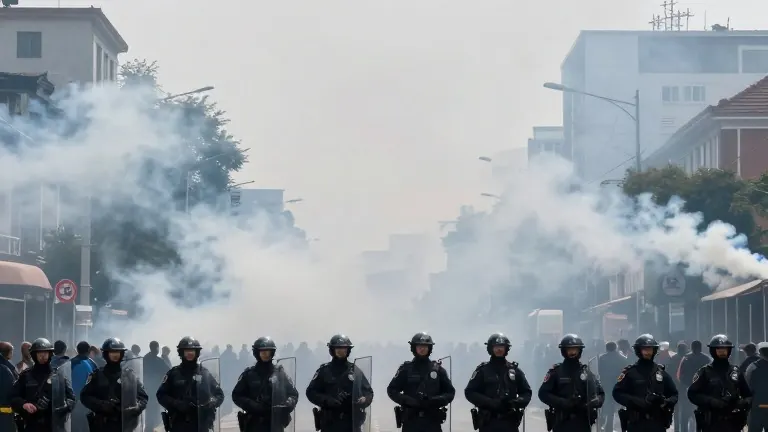
French police face intense scrutiny over their riot-control methods after a wave of protests left several teenagers with permanent disabilities.
During demonstrations last Saturday against rising living costs and school conditions, a 17-year-old girl in Mulhouse lost an eye and a 17-year-old boy in Saint-Etienne lost a hand. The Interior Ministry reported that 997 officers and gendarmes were injured in the unrest, with seven of those injuries classified as serious. Police stated that more than 100 protesters and residents were hurt in Paris alone, while roughly 2,400 people were arrested across the country that day.
Authorities have announced reinforcements for further demonstrations expected this Saturday. Interior Minister Laurent Nuñez issued instructions the day before the recent protests, stating that police and gendarmes should be able to use the entirety of the intermediate weapons at their disposal. The French National Police described these tools as defensive response instruments that allow officers to address threats in a graduated and proportionate manner.
The equipment includes batons, tear gas, sound grenades, and foam-round launchers. Riot shields are fitted with powerful strobe lights intended to disorient crowds. Electric stun guns are prohibited in these operations. Amnesty International called for a permanent ban on stun grenades earlier this month, noting that the devices were originally developed for military training and high-risk hostage situations. Patrick Wilcken, an arms researcher at the group, said the weapons were never really meant for policing of protests.
Foam-round launchers draw particular criticism from human rights advocates. United Nations guidance states that kinetic impact projectiles should target only the abdomen to avoid severe harm to the head or neck. Neil Corney, an arms researcher at the U.K.-based Omega Research Foundation, warned that foam rounds can kill in certain circumstances. He noted that injuries declined in Spain after authorities replaced rubber-bullet shotguns with foam launchers and improved training.
Accountability remains a challenge because foam rounds rarely leave traceable evidence. Activists have suggested stamping identification numbers on the projectiles to help identify the officers involved in serious incidents. Corney said this measure would greatly improve accountability at little cost.
Jean-Marie Godard, an author specializing in French internal security, said the current tactics reflect a shift away from community policing toward specialized riot-control units. This change began in the early 2000s when the conservative government moved away from foot patrols. Laura Keesmann, a sociologist at the University of Antwerp, observed that French policing is more authoritarian than in other European countries studied. She noted that officers in France often keep a distance from protesters, whereas their counterparts in the U.K., Netherlands, and Sweden frequently engage directly with crowds to defuse tensions.