Iowa faces nitrate water crisis
Decades after blue baby syndrome was largely eradicated, rising cancer rates and manure runoff have renewed debate over federal water standards.
By Jack Weber ·
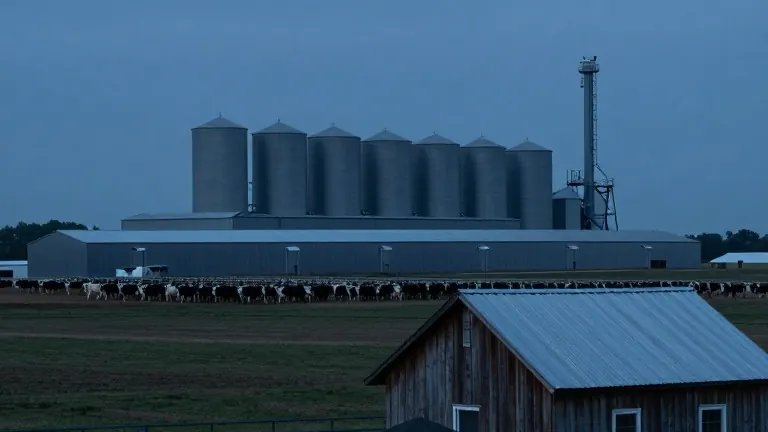
Residents in Iowa are witnessing a shift in water quality concerns that mirrors a historical medical crisis. While the state treats water to federal standards, nitrate levels remain high due to synthetic fertilizer and manure runoff. The state now hosts nearly 11,000 factory farms that produce more than 170 billion pounds of manure annually. This industrial scale has placed the state at the center of a new public health debate.
The current focus has moved from infant illness to adult cancer. Many residents view the state's rising cancer rates as a direct link to industrial agriculture. They are urging researchers and lawmakers to act on the connection between nitrate exposure and long-term health risks. However, experts note that the data supporting this link is less straightforward than the evidence for the earlier infant condition.
The historical context traces back to a 1945 report by Dr. Hunter H. Comly. His work in the Journal of the American Medical America Journal connected blue baby syndrome to nitrate pollution near farms. The condition, known as methemoglobinemia, causes skin to turn blue due to a lack of oxygen in the blood. It was treatable with a substance called methylene blue. Comly’s paper became a cornerstone for federal clean water regulations.
In the mid-20th century, the condition was prevalent in the Midwest. Between 1947 and 1949, Minnesota recorded 139 cases, including 14 deaths. By 1951, hundreds of infants across several states had been diagnosed, and 39 had died. A literature survey by sanitary engineer Graham Walton at the U.S. Public Health Service highlighted the severity of the issue. This data prompted the first nitrate drinking water standard in the country.
The standard was set at 10 milligrams per liter of nitrate-nitrogen. Comly originally suggested this limit in 1945, though he noted the uncertainty in the data. The U.S. Public Health Service adopted the same figure in its 1962 drinking water standards. This limit has remained the benchmark for safe water, despite evolving scientific understanding of how nitrate affects human health over extended periods.
Political will to update this standard is currently limited. The latest Trump administration has closed the office responsible for scientifically reevaluating the limit. The U.S. Environmental Protection Agency stated that the work was largely transitioned to a different office. They also determined that the nitrate standard is not a candidate for revision at this time. This decision has drawn criticism from environmental groups who argue for stricter limits.
Michael Schmidt, general counsel for the Iowa Environmental Council, argues that more action is needed. He told Sentient that the blue baby effect is a short-term issue, whereas cancer risk results from extended exposure. Research increasingly shows that long-term exposure to elevated nitrate levels increases cancer risk. Schmidt noted that cancer is a complex condition that requires a different regulatory approach than the acute infant illness.
The connection to agriculture has been a point of contention for decades. Early researchers noted that wells near barnyards and privies had the highest nitrate levels. Walton’s 1951 report found that 83 of 129 wells involved in methemoglobinemia cases were within 50 feet of a source of animal or human contamination. Despite this, the farming industry continued to rely on nitrogen fertilizers and animal feedlots.
Media coverage in the late 1960s began to link nitrate pollution to these agricultural practices. Editors in Illinois and Minnesota called attention to fertilizers and feedlots as key sources of nitrogen pollution. Pro-agriculture groups responded to the growing environmental movement, creating a tug-of-war that continues today. The current debate over cancer rates and water standards reflects this long-standing tension between public health and industrial agriculture.