North Texas Rail Agencies Push for Regional Integration
Leaders from Trinity Metro, DART, and DCTA outlined plans to connect systems, expand service to 12.5 million projected residents, and address funding gaps.
By Alexei Brooks ·
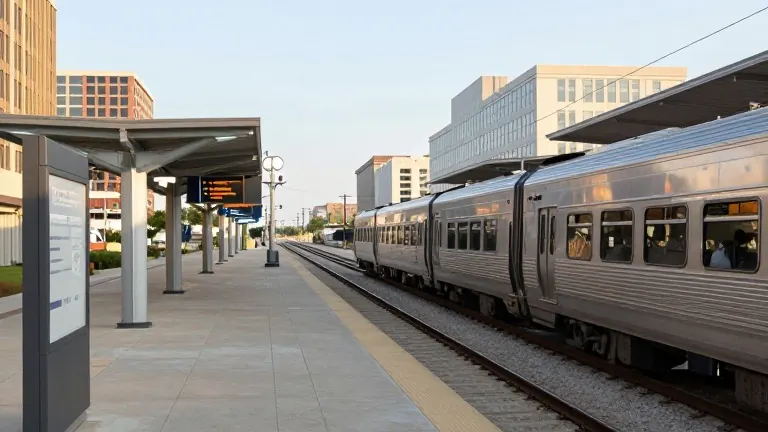
Three passenger rail systems in North Texas are moving toward a unified regional network to address growing traffic congestion. The push comes as the region’s population is projected to reach 12.5 million by 2050, a figure that current infrastructure may not support. Leaders from Trinity Metro, the Dallas Area Rapid Transit, and the Denton County Transportation Authority presented their coordination efforts on Tuesday.
Michael Morris, the North Texas transportation director for the Regional Transportation Council, told the 2026 Commuter Rail Summit that expansion is necessary to relieve gridlock. He stated that the agencies are beginning an institutional process to determine if existing entities can form the backbone of a new system. The goal is to establish high-speed rail connecting downtown Fort Worth, Arlington, Dallas, Houston, Austin, and San Antonio.
Trinity Metro recently broke ground on a $270 million extension of its TEXRail line into Fort Worth’s Near Southside and Medical District. The 2.1-mile addition will connect the existing 27.2-mile line, which runs from downtown Fort Worth to the Dallas Fort Worth International Airport, to 50,000 local jobs. Officials expect the extension to be complete by mid-2030. The agency also aims to extend service to TCU and the southwest campus of Tarleton State University.
Rich Andreski, president and CEO of Trinity Metro, said the agency is thinking bigger regarding development. He cited the $20 million investment in the Grapevine rail station as a successful model for transit-oriented projects. Andreski noted that Trinity Metro is currently working with the city of Fort Worth to adjust zoning laws to encourage similar development near other stations.
Nathaniel Ford, who took over as DART CEO 12 days ago, reported that the agency has developed 37 transit-oriented projects. These projects provide a total economic benefit of $1.93 billion. DART launched the 26-mile Silver Line from Plano to the airport in October 2025. Ford addressed concerns from member cities about financial returns, noting that Highland Park recently left the system. He said DART is advancing service through long-term leases with partners and universal regional fares.
Ford mentioned that proposed legislation in the 90th Texas Legislature in 2027 seeks to expand the DART board to more than 20 members. The change aims to equalize voting power so that no single city holds disproportionate influence. Ford stated that this adjustment would bring a greater level of representation for all participating cities.
Paul Cristina, CEO of the Denton County Transportation Authority, outlined plans to link the agency's 21-mile A-train to downtown Carrollton. This connection would allow transfers to the Silver Line and DART light rail. The A-train currently runs parallel to Interstate 35E from downtown Denton to Trinity Mills Station. Cristina said DCTA is also collaborating with Lewisville officials to build a mixed-use development on a 13-acre site in the downtown area.
Morris argued that expanding rail boundaries to include more cities would increase funding. Transportation studies indicate that many residents in nonparticipating cities already use the systems. He referred to this as a key component of Transit 2.0, North Texas’ $217 billion 2050 transportation plan. Cristina concluded by stating that the objective is to meet the tailored needs of cities while providing service.