House Fight Hinges on 46 Tilted Districts and Seven New Maps
With a three-seat margin separating control of the House, voters in 46 battleground districts and seven redistricted states will determine the balance of power.
By Arjun Weber ·
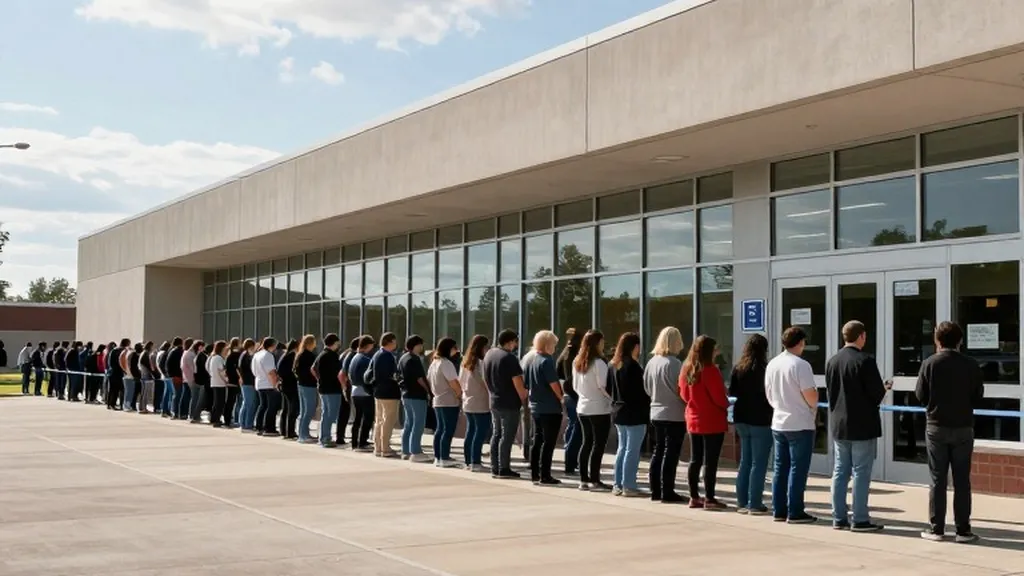
All 435 seats in the U.S. House of Representatives are up for election today, marking the midpoint of President Donald Trump's second term. The current composition of the chamber is razor-thin, with Republicans holding 218 seats and Democrats holding 214. This leaves a margin of only three seats that determines which party controls the legislative agenda. Democrats require a net gain of three districts to secure a majority, while Republicans can afford to lose no more than two seats to maintain their hold. This narrow split places the entire outcome in the hands of voters in a specific subset of competitive races across the country.
Ballotpedia identifies 46 districts as battlegrounds, with 25 currently held by Democrats and 21 by Republicans. These districts are considered pivotal because they are likely to decide the fate of the chamber. The political dynamics in these areas are complex, as 21 of the Democratic-held districts voted for President Trump in the 2024 presidential election. Conversely, nine Republican-held districts cast their ballots for former Vice President Kamala Harris. This cross-over voting pattern suggests that voters in these districts may prioritize local candidates or specific issues over the national party ticket, making the outcome difficult to predict.
Adding to the complexity of the map are new congressional boundaries in seven states. California, Florida, Missouri, North Carolina, Tennessee, and Texas are all using new maps following mid-decade redistricting. Ohio also utilizes a new map for this cycle. These changes have shifted the political landscape in several key districts. Republican candidates hoped that these redistricting efforts would help them beat the historical trend of a president's party losing seats in midterm elections. However, new districts in Florida and elsewhere may not vote as they were drawn, creating uncertainty for both parties.
The Associated Press describes the election as a referendum on the president's second term, noting that voters are struggling with high prices and are angry over an unpopular war with Iran. Recent polling indicates that 35 percent of U.S. Adults approve of Trump's job performance, while only 25 percent approve of his handling of the economy. About seven in 10 respondents say the country is heading in the wrong direction, with most blaming the president for rising costs. These economic concerns are likely to influence how voters cast their ballots in the 46 battleground districts where the House majority will be decided.
Republican leadership is focused on voter turnout to maintain their slim majority. RNC Chairman Joe Gruters stated that everything depends on turnout, asserting that if they turn out their voters, they will win. He emphasized that this has been the core of their planning strategy. In contrast, Democratic leadership is framing the election as a vote for change. DCCC Chair Rep. Suzan DelBene said the American people are angry and want change. She argued that the current economic conditions warrant a shift in control to the Democratic caucus. Both parties are relying on these narratives to mobilize their bases in the critical districts.
The financial stakes of this election are historic, with the 2026 cycle likely to be the most expensive in history. Republican committees have outraised and outspent their Democratic counterparts, aided by Trump-affiliated groups and Elon Musk. However, at the candidate level, Democrats have managed to outraise their opponents. An analysis of AdImpact data shows that 88.1 percent of Republican general election TV ad spending went to states and districts that Trump won in 2024. This includes more than 850 million dollars spent in areas where he won by 10 points or more, indicating a heavy investment in defending safe seats and consolidating support in key regions.
Voter sentiment on the ground reflects the national mood of economic anxiety. James Moore, a 57-year-old librarian in Raleigh, North Carolina, said that he is paying more taxes, more for healthcare, and more for everything. His comments mirror the feelings of many voters in the battleground districts. On the other side, Mark Barker of Palm Beach Gardens, Florida, said he has been following Trump the whole time and believes he is doing an awesome job. These individual experiences highlight the divided nature of the electorate that will determine the outcome of the House race.
The administration's involvement in election administration has also become a focal point for voters. A federal judge temporarily barred the Trump administration from carrying out a plan to prevent noncitizen voting, a move critics say risks disenfranchising eligible voters. Another judge ordered the administration to stop demanding that California election officials segregate ballots cast by people on lists of suspected noncitizens. These legal battles are part of a broader concern among Democrats about interference and intimidation, as the Justice Department threatens to prosecute local election officials. The U.S. Postal Service has added hours and staff to ensure mail ballots are counted on time, a crucial step given the high volume of early voting.
More than 57 million people had already voted as of Monday, surpassing the early vote totals from four years ago in many closely watched states. This surge in early voting suggests a high level of engagement that could impact the final count in the 46 battleground districts. The AP notes that one or two seats could tip either chamber, making every vote in these competitive areas potentially decisive. As polls close across the country, the focus remains on these specific districts and the seven states with new maps, where the next Congress will be shaped.